Strategic Curation & Content Selection
Curation means cutting. Quality over quantity. Reviewers look at hundreds of portfolios. One great spread will stick with them more than twenty average pages. Almost without exception, shorter portfolios are stronger portfolios.
Your first instinct as a student is to show everything. Resist this. Your strongest portfolio will leave out 80% of what you have made. The 20% that remains should be so well-chosen and well-ordered that every page earns its place.
Quantitative Guidelines for Portfolio Scope
- For students: 15–25 high-impact images/pages for a full portfolio. Each project should occupy 2–4 pages.
- For professional sample portfolios: 2–5 A3/A4 pages of absolute best work. This is your leave-behind or website gallery.
- For internship applications: 8–12 pages showing range across typologies and scales.
- For graduate school: 20–30 pages with emphasis on process and research methodology alongside resolved design work.
KEY INSIGHT: Lead with your strongest project. It is your professional handshake. Within the first 30 seconds of viewing your portfolio, the reviewer should encounter work that is technically proficient, visually compelling, and clearly communicated. This establishes credibility and sets expectations for everything that follows.
The Selection Matrix: Strategic Project Selection
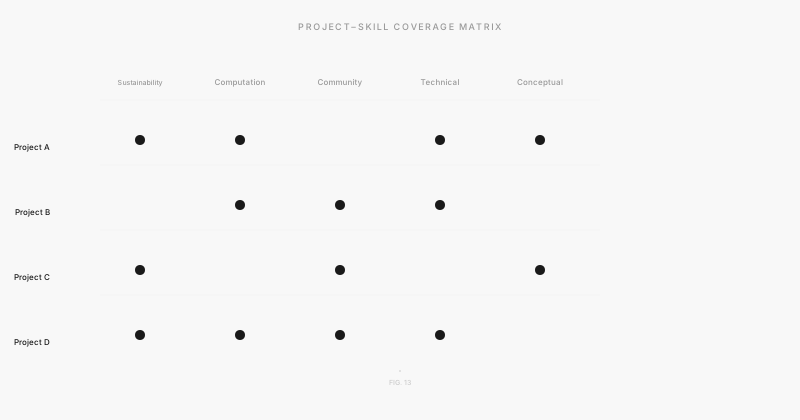
Create a matrix with your projects on one axis and key skills on the other: sustainability, computational design, community impact, technical resolution, conceptual innovation, diverse scales, diverse typologies. Each selected project should illuminate multiple cells in this matrix. No project should address only one skill or demonstrate only one scale of work.
Documentation and Process Work
For each project, document the design process at multiple stages:
- Initial Ideation: Raw concepts, early-stage sketches, "napkin" drawings, mood boards
- Research and Analysis: Site constraints, cultural contexts, environmental data, material studies, precedent analysis
- Prototyping: Physical and digital models showing evolution of form, sectional studies, volumetric explorations
- Technical Resolution: Detailed plans, sections, details, construction drawings, material specifications