Storyboarding & Visual Sequencing
Storyboarding is the process of sequencing images and text to communicate a design narrative. In film, storyboarding sequences shots to create emotional and narrative momentum. In portfolio design, storyboarding sequences images and diagrams to guide the viewer through your design logic.
Four Types of Portfolio Drawings
Before sequencing, categorize your visual content by what it communicates. Not all images serve the same function, and knowing what role each drawing plays helps you build a sequence that actually tells a story.
- Context drawings: Site photographs, mapping studies, environmental data, precedent analysis. These establish the problem and frame the design challenge.
- Process drawings: Diagrams, early models, iterative sketches, analytical drawings. These show how you think about the problem and how the design idea evolved.
- Technical drawings: Plans, sections, details, structural logic, material specifications. These demonstrate technical competency and show that the design is buildable.
- Experience drawings: Renders, spatial perspectives, atmospheric visualizations, user scenarios. These show what it feels like to inhabit or experience the final design.
Every drawing in your portfolio belongs to one of these four categories. If you cannot identify which category a drawing serves, it may not belong in the sequence.
Project-Level Sequence Structures
Within a single project, three sequence structures are common:
- Linear Narrative: Site → concept → development → resolution. Works well for process-driven projects where the evolution of the design is central to the story.
- Comparative Narrative: Before/after, existing/proposed, or multiple design alternatives. Effective for renovation projects or when showing the impact of your design moves.
- Thematic Narrative: Organized around a design principle (materiality, phenomenology, sustainability) rather than chronology. Shows how multiple design decisions reinforce a central concept.
Portfolio-Level Sequencing
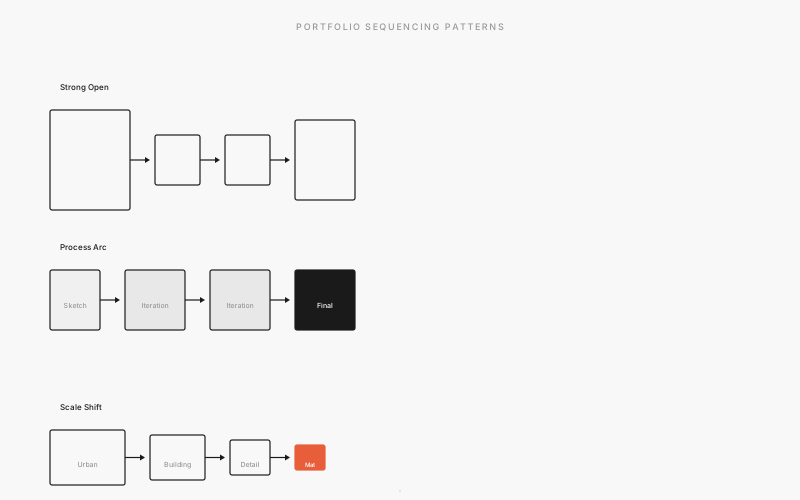
The same logic applies to how you order projects across the full portfolio. Three effective approaches:
- Thematic Arc: Projects organized around a design principle or methodology (e.g., adaptive reuse, community engagement, material innovation) rather than chronology
- Scale Progression: Moving from detail to larger context, or vice versa, to show versatility across scales
- Evolution of Thinking: Projects sequenced to show intellectual development and refinement of a central design thesis over time
The Two-Track Reading System
Design your project spreads to function at two simultaneous speeds:
- Track 1. The Skim (30–90 seconds): Large images, clear hierarchy, minimal text. A reviewer scanning quickly should understand your project's core idea from layout and images alone.
- Track 2. The Study (5–15 minutes): Captions, process documentation, analytical detail. For the viewer who engages more deeply, provide text and diagrams that explain design logic and technical decisions.
Captions and the Relay Method
Text and image should complete each other rather than duplicate. A caption that merely labels what is already visible adds nothing. A caption should provide information the image cannot convey on its own: the reason for a design decision, the constraint that shaped the form, or the outcome that resulted.
KEY INSIGHT. The Relay Method: Treat captions as a relay race where text and image hand off the baton. The image shows the form; the caption explains why that form was chosen. The image demonstrates materiality; the caption explains the performance benefits or user experience those materials enable.