Audience & Strategic Tailoring
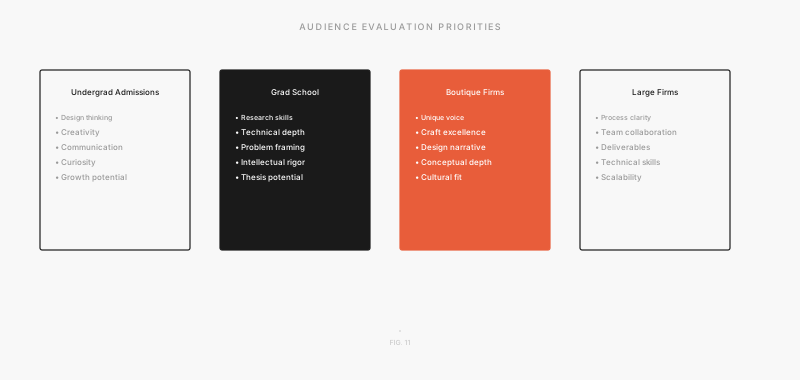
Who is going to look at your portfolio? That question should shape everything: what you include, how you organize it, and what you emphasize. Generally, portfolios are reviewed by two kinds of audiences: academic admissions committees and professional firms. Each group looks for different things.
A portfolio that works for a grad school application might fall flat at a corporate firm. One tailored to a small sustainable design studio might not land at a large infrastructure practice. Know your audience before you start building.
Target Audiences and Evaluation Criteria
| Target Audience | Primary Focus | Evaluative Criteria |
|---|---|---|
| Undergraduate Admissions | Creative potential and observational skills | Curiosity, interest in space, experimental thinking, visual sensitivity |
| Graduate School (M.Arch / MLA) | Research agenda and critical thinking | Depth of research, process documentation, clear methodology, original thinking |
| Boutique Design Firms | Versatility and design sensibility | Alignment with firm niche, hands-on ability, creative freedom, design philosophy |
| Large Corporate Firms | Technical proficiency and team integration | BIM expertise, specialization, large-scale project experience, process understanding |
PRO TIP: An application to a firm known for sustainable urbanism should foreground projects that utilize environmental modeling and site analysis, whereas an academic application might prioritize hand-drawn sketches and conceptual models that showcase raw creativity. Tailor the visual and narrative emphasis to match the values of your target audience.
Audience-Specific Portfolio Strategies
For Academic Audiences: Emphasize process: sketches, diagrams, analytical drawings. Show how your thinking developed. Include dead ends or alternative approaches you explored. Admissions reviewers want to see how you learn and grow, not just your best final images.
For Professional Firms: Lead with resolved, professional work. Show your ability to produce publication-quality graphics and technically sophisticated drawings. Highlight projects at scales and typologies that match the firm's portfolio. Demonstrate that you understand professional constraints: budgets, timelines, regulatory requirements.
The Tailored Portfolio Approach
While it is ideal to maintain a core set of strong, broadly relevant projects, consider developing tailored versions of your portfolio for different contexts. If you are applying to both academic programs and professional firms, your academic portfolio might emphasize research methodology and conceptual exploration, while your professional portfolio highlights technical proficiency and project resolution. This is not deception; it is curation.